

"We don't leave anyone out in the rain"
Juliane Schreiber & Christof Schaffer
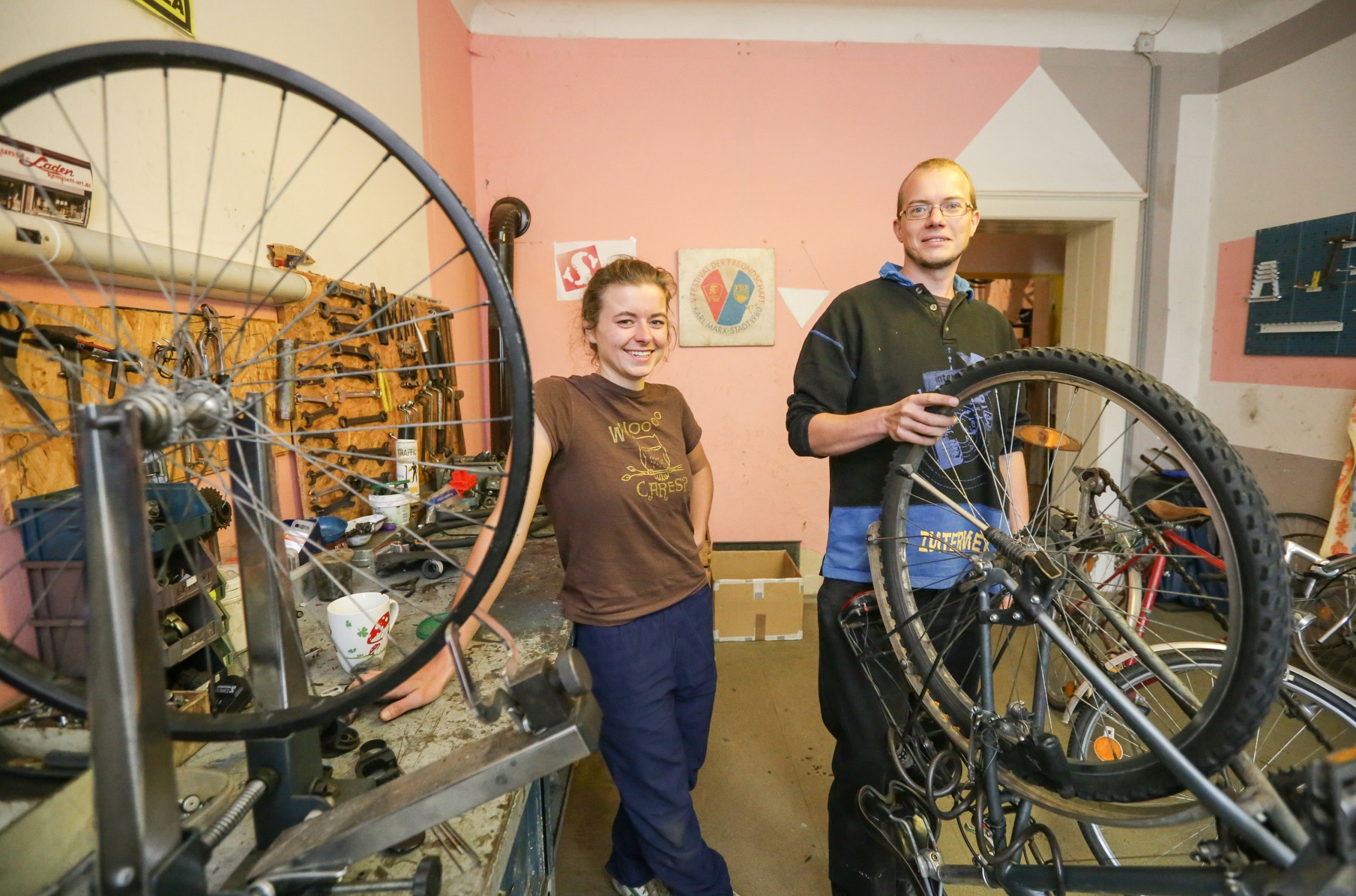
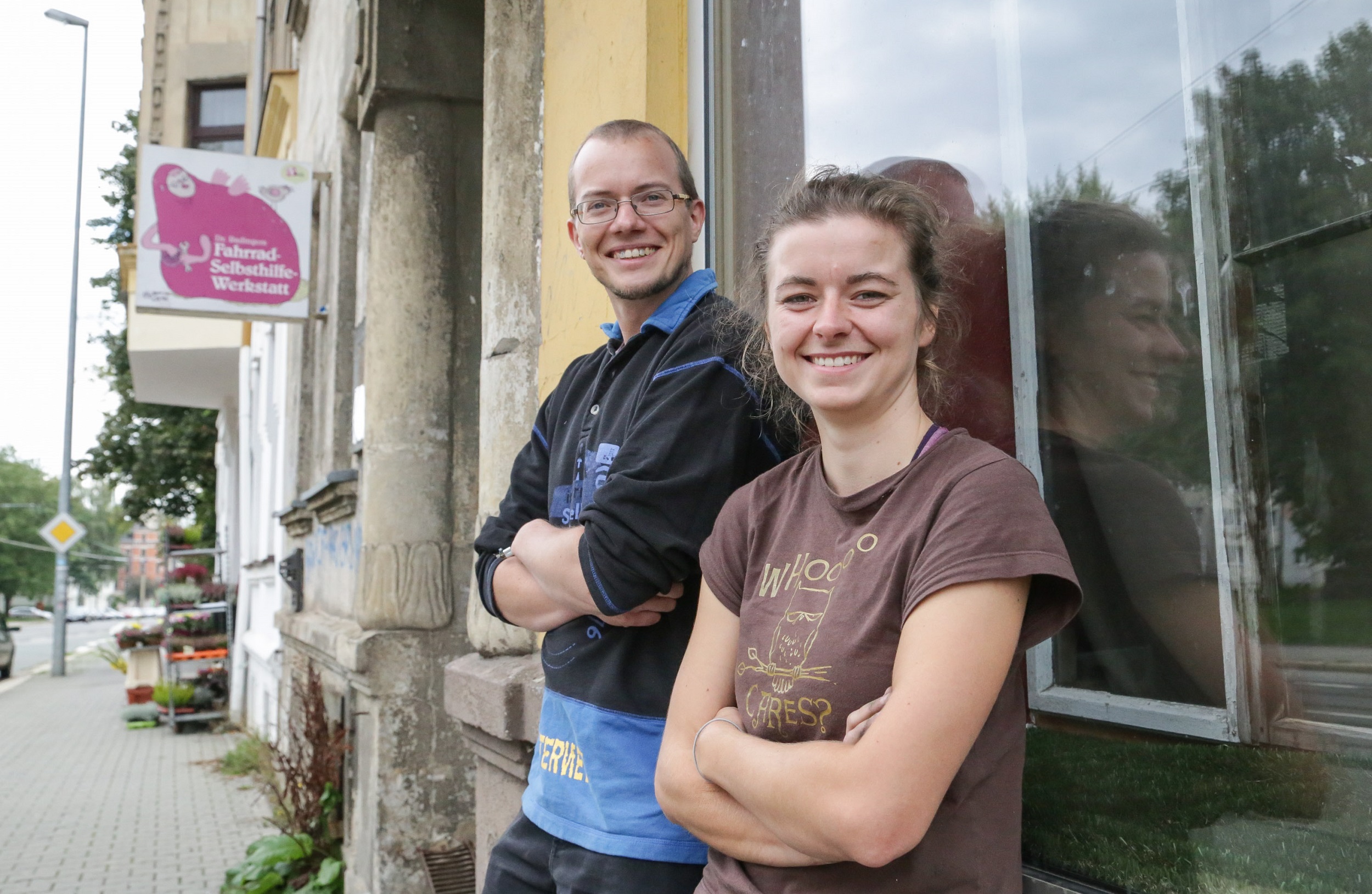
Do you know the feeling? You get up early, the weather is nice and you think: "I'm going to cycle today." On the way to the cellar, you're looking forward to finally doing something for your health and fitness. And just as you're about to get the bike out of the cellar, you realise: "Oh yes, I've got a flat tyre." So you close the cellar and get on the bus or train. - But that doesn't have to be the case! The Dr Radinger bicycle self-help workshop at Bernsdorfer Straße 41 can help you. Whether it's a flat tyre, a broken dynamo or a missing bell. Juliane Schreiber and Christof Schaffer are on hand every Tuesday to offer help and advice. Do you know this? You get up early, the weather is nice and you think: "I'm going cycling today." On the way to the basement, you're looking forward to finally doing something for your health and fitness. And just as you're about to get the bike out of the cellar, you realise: "Oh yes, I've got a flat tyre." So you close the cellar and get on the bus or train. - But that doesn't have to be the case! The Dr Radinger bicycle self-help workshop at Bernsdorfer Straße 41 can help you. Whether it's a flat tyre, a broken dynamo or a missing bell. Juliane Schreiber and Christof Schaffer are on hand every Tuesday to offer help and advice.
How did the bicycle self-help workshop develop?
Juliane Schreiber: The workshop was originally set up in the former squat in Reitbahnstraße. The self-help workshop had always been there, but I think more unofficially. I happened to find a flyer in the university canteen at the time and found out about the workshop. That's how I got to know the owner at the time. At some point, they had to move out of the building in the "Reba" and moved in here.
Christof Schaffer : In organisational terms, the workshop is run by the TU Student Council (StuRa); it used to be run by the Transport Department. We are now our own department. But we came to this rather like the virgin to the child. The StuRa supports us with a bit of money and finances our premises.
If you don't get that much money, do the cyclists who come here have to pay anything?
Juliane Schreiber: We have a donation box. Of course, this is only ever an indication, but not an obligation. Nevertheless, a donation is always welcome.
Christof Schaffer: We are also thrifty. We get the money from the StuRa mainly for tools and consumables. The things that need to be replaced regularly on the bike because of wear and tear are financed this way. There are no fixed prices. If someone wants to pay for something, they can put the money in the donation box. That always helps us, of course.
Do you then repair the bikes, or should they do it themselves?
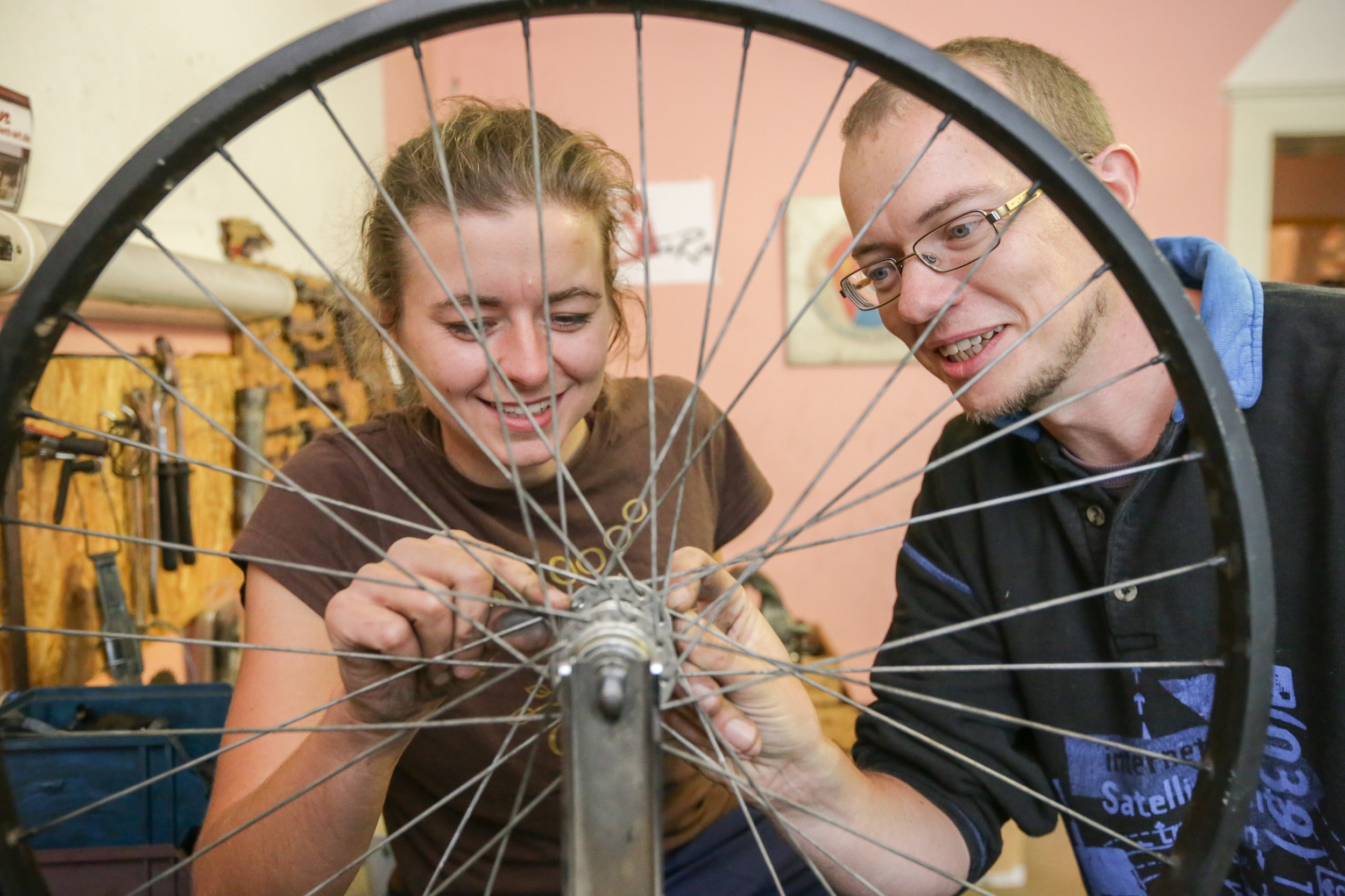
Juliane Schreiber: The basic idea is that everyone repairs their own bike. But we don't leave anyone out in the cold.
Christof Schaffer: We are really only there to provide guidance. Of course, we also lend a hand when things get tricky, but basically it's self-help, as the name suggests. We give people a hand, but they should actually manage it on their own.
Juliane Schreiber: Due to the crowds we have here every week, repairing things does involve a bit of a wait.
How many people come?
Juliane Schreiber: We've lost count.
Christof Schaffer : It actually varies a lot, depending on the weather and the time of year, of course. But it doesn't take long before the room here is full. And full means that there are five cyclists with their bikes in the workshop. We are right in the middle of it all and try to get involved. And then it doesn't take long before there are still people in the anteroom and outside the door. That's also difficult for us to organise now - neither with the space nor with the number of staff.
So you are open to people who would like to help out?
Juliane Schreiber: In principle, yes, but the space problem is still not solved. There's no point hiring more helpers if there's no space here and there aren't enough tools. We don't have ten copies of everything.
Christof Schaffer: On the other hand, more helpers can also take the pressure off us. So that we can divide up the work and the weeks. At the moment, we really are here every Tuesday to run the workshop.
Are your "customers" mainly students, or do others come too?
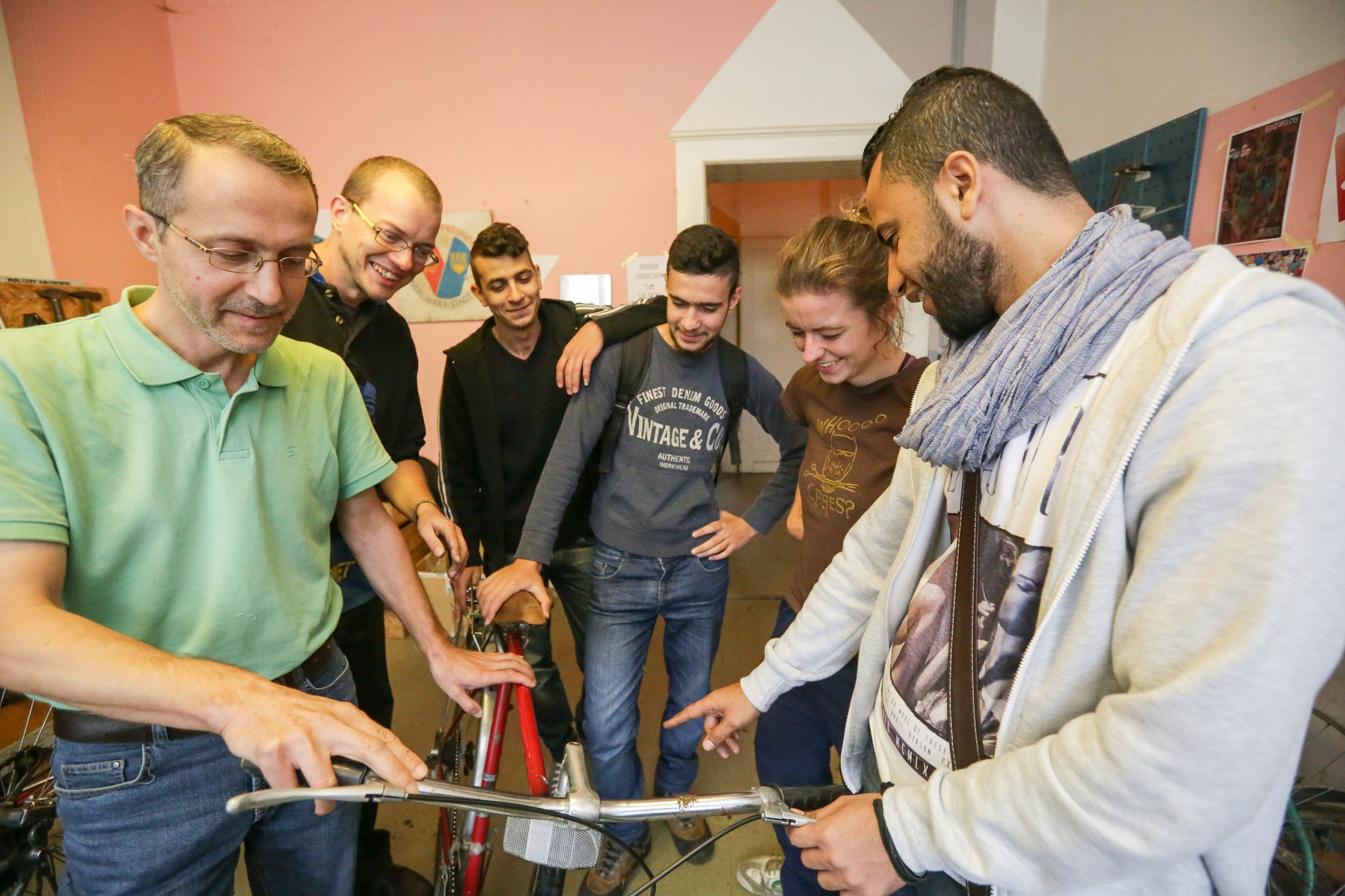
Christof Schaffer : In the meantime, students are actually more of a minority. Last year we had a campaign day with the Saxon Refugee Council. We gave out bicycles for refugees and asylum seekers to use. Word got around very quickly and we are now less of a contact point for students and more for migrants, refugees and asylum seekers.
Can people now hand in bicycles that you collect here for refugees and you then pass them on?
Juliane Schreiber: Yes, refugees very often come by here and don't just want to repair bicycles, but would like to have one so that they can be mobile. So if anyone has an old bike in the cellar that they no longer need, they are very welcome to hand it in to us.
It's now just before 4 p.m. and the rush to the bike workshop is slowly becoming noticeable. The two of them also try to give the refugees instructions and explain the best way to repair something. They don't always succeed, but in the end the bike is built and in working order. "Sometimes we do it ourselves," says Christof and explains that the language barrier in particular is often quite big. But there is always a degree of cooperation.
Perhaps refugees who need help will also come to the European Mobility Week. You have a stand there on Friday. What are you bringing with you?
Juliane Schreiber: We'll be offering a kind of workshop station where you can quickly inflate your tyre or do small, quick repairs. And Mobi Week is of course an opportunity to make us a little better known.
Christof Schaffer: A mobile field workshop, so to speak. Let's see if it's very popular. We've done something like this on the Sonnenberg before and it was pretty well received.
How important is cycling to you?
Juliane Schreiber: Very important! My bike is actually my main means of transport. My bike broke down ages ago and, for whatever reason, I didn't manage to fix it for a while. I felt like I'd been amputated somehow. I just couldn't get away. I didn't know how I was going to get around without a bike. I'm not a fan of travelling by bus and I don't like walking either. So it was quite strange without a bike.
Christof Schaffer: For me, the bus is always an option, but I still really like travelling by bike. You're simply more flexible on a bike, you don't have to follow a timetable. You can cycle when and where you want. The bike is always waiting!
Are the people of Chemnitz typical cyclists?
Christof Schaffer: Well, I think there's still some catching up to do compared to other cities. There are German cities where there are huge numbers of cyclists. That's not so noticeable here. On the other hand, cycling here is much more relaxed. If you know your way around and know your corners, you can make good progress. A wonderful route is along the Kappelbach - from Falkeplatz out to Mittelbach or Grüna.
Juliane Schreiber: Or you can cycle very well to Sigmar. Out of Kaßberg, to the club cinema or to Rabenstein. There are nice cycle paths there. However, I have to say that a lot can still be done in the city to make cycling more pleasant and attractive. Sometimes you need a thick skin to cope with the many roads without cycle paths.
Christof Schaffer: If you want to cycle in Chemnitz, you need a little bit of fitness. Topographically, it's not for everyone. It's a good idea to cycle regularly so as not to get out of practice. However, there are also valleys where you can cycle beautifully. For example, along Bernsdorfer Straße or Augustusburger Straße.
The bicycle workshop is more of an alternative project. Are there any other projects or events in Chemnitz that you can recommend and are you networked with each other?
Juliane Schreiber: The first thing that comes to mind is "Zukunft" on Leipziger Straße.
Christof Schaffer: I'm thinking of the Sonnenberg. There's a repair café there where you can also repair things other than bicycles. There are also various workshops there and so on. There were the beginnings of a network, but not much has come of it. Well, there's always something going on culturally in Chemnitz. No matter what you want to do, you can always find something. It doesn't necessarily have to be alternative.
Juliane Schreiber: I think there are some very nice events in the city that can be recommended. The "Küchwaldrauschen" and "Fuego a la isla" in particular are very nice festivals.
Do you have to encourage the people of Chemnitz?
Christof Schaffer: Perhaps not courage, but a bit more enthusiasm, motivation and openness. Just open up to things more quickly.
Juliane Schreiber: When there are new ideas or projects, I sometimes get the impression that some people are very slow to react. You often need a lot of patience. Especially when it has to do with financial factors, you not only need patience, but also the necessary small change to bridge the dry spell. But once this is over and people have gained confidence, it can work very well.