

Sewage disposal
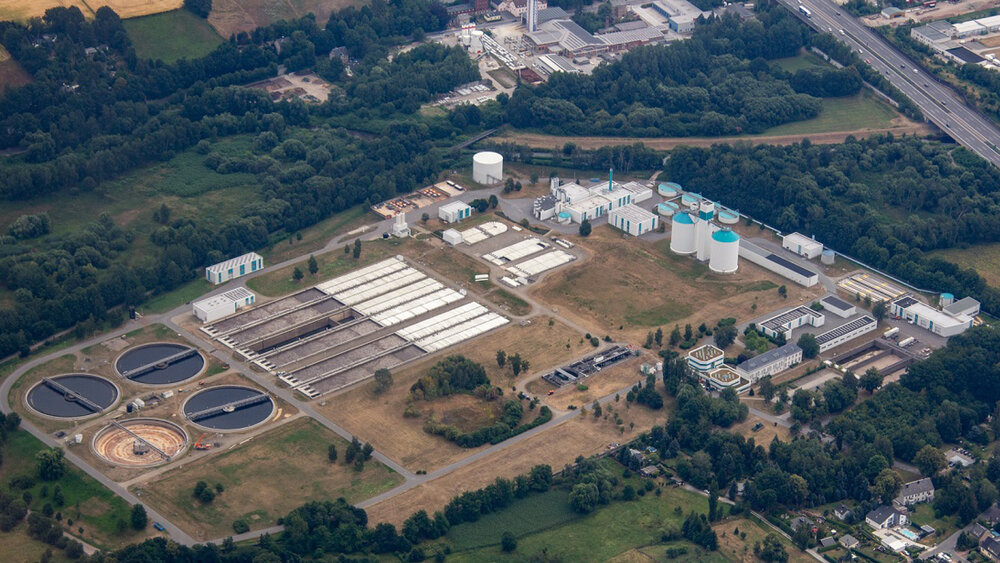
Achieved status of wastewater disposal
According to the German Federal Water Act (WHG), wastewater[1] is
- water whose properties have been altered by domestic, commercial, agricultural or other use (wastewater) and
- water collected from precipitation from built-up or paved areas (rainwater).
Regardless of the quantity, the city of Chemnitz, represented by the waste management company of the city of Chemnitz (ESC), is obliged to hand over wastewater[2]. Environmentally friendly treatment of the wastewater produced is an important prerequisite for impeccable hygiene, the necessary protection of water bodies from contamination and the further development of residential areas. Wastewater may only be discharged into a body of water if it has been treated using state-of-the-art technology.
Since the 1990s, Chemnitz has also invested heavily in wastewater treatment plants in order to increase the connection rate to the centralised wastewater disposal system. Today, 98.6 % of Chemnitz residents are connected to the city's centralised wastewater facilities (as of 06/2020). The collected wastewater is channelled via the extensive sewer network to the central sewage treatment plant in Chemnitz-Heinersdorf, where it is treated in a modern large sewage treatment plant before being discharged back into the Chemnitz.
Legal basis
Further information
Waste disposal company of the city of ChemnitzTel.: 0371/4095-400
Wastewater disposal for properties without centralised access
Residential and commercial properties

After completion of the development measures in accordance with the wastewater disposal concept of the City of Chemnitz (ABK), there will be no direct connection option to the central sewer network to the wastewater treatment plant in Chemnitz-Heinersdorf for approx. 1,400 residential and commercial properties, even in the future.
The affected property owners must therefore construct and operate private decentralised wastewater systems that are state of the art. According to the requirements of the Saxon Water Act and the Saxon Small Wastewater Treatment Plant Ordinance, existing small discharges had to be adapted to the state of the art by 31 December 2015 at the latest. This has been almost completely finalised in Chemnitz. The operation of mechanical or partially biological small wastewater treatment plants is no longer permitted.
Weekend and recreational properties
Weekend and recreational properties are not used all year round. As a result, the amount of wastewater produced is intermittent. As wastewater treatment in modern fully biological small wastewater treatment plants is carried out by microorganisms, these plants require the most uniform possible feed of wastewater throughout the year. This means that for weekend and recreational properties, the only option is usually to install a septic tank without a drain.
The size and location of this pit as well as the disposal methods must be agreed with the waste disposal company of the City of Chemnitz (ESC) on a case-by-case basis.
Gardens in allotment garden associations
To date, there is no sewage disposal solution for allotment gardens that is suitable for all plots. According to the Federal Allotment Garden Act, allotment gardens may not be used as residential accommodation. The legislation assumes that, as a result, no sewage is produced. As is evident from numerous discussions with allotment gardeners, the reality is quite different.
Small-scale sewage treatment plants are not an option, just as they are not for weekend and recreational plots. Furthermore, the installation of a closed-system collection pit is only feasible in very few cases, as the garden paths are generally not wide enough to allow the disposal vehicle to access the individual plots. The current Framework Regulations for Allotment Gardens of the Saxony Regional Association of Allotment Gardeners state the following in section 6.2: “Septic tanks are prohibited. Collection pits are only protected under grandfathering provisions if they were installed before 3 October 1990 in accordance with the law in force at the time. Their use is subject to compliance with the applicable or local regulations regarding proof of watertightness and disposal. Copies of proof of disposal must be submitted to the executive committee and retained for 10 years after the change of plot. It is not permitted to collect faecal matter in leaky containers, allow it to seep away, or apply it directly to plants.”
From the water authority’s perspective, the preferred solution should therefore be to install central toilet facilities at the clubhouses, which can be used by club members. In addition, there is also the option of setting up central collection points for faecal matter and having these disposed of by the ASR. This must be agreed in detail with the ESC in advance. Alternatively, camping and chemical toilets may be used. Since 1 January 2026, camping toilets can no longer be disposed of at recycling centres. A newly established collection point is now available in the car park of the Jutta Müller Ice Sports Centre, Wittgensdorfer Straße 2a.
Further information
Infiltration of domestic wastewater
Fully biologically treated wastewater that cannot be discharged into a surface water body can be infiltrated into the groundwater if the subsoil at the site permits this. For this purpose, the soil must not only be sufficiently permeable, but there must also be no permanent or long-term waterlogging up to 1 metre below the base of the infiltration system.
As a rule, infiltration takes place by means of an infiltration trench or an infiltration trough. Only in justified exceptional cases is localised infiltration via an infiltration shaft permitted. The generally recognised rules of technology in accordance with DIN 4261-5:2012-10 must be observed both during the construction and operation of the infiltration system.
The infiltration of domestic wastewater constitutes a use of water for which a permit under water law is required[1], [2] The construction and operation of the infiltration system itself also requires a permit[3].
The quantity and harmfulness of the wastewater must be minimised as far as possible according to the state of the art when discharging into groundwater or into surface waters[4], [5].
The state of the art is concretised by the Wastewater Ordinance, whereby further requirements for the discharge can also be specified in the water law permit[6].
Domestic wastewater may not be infiltrated together with rainwater.