Changes to the new local transport network from the end of February
Joint press release by the City of Chemnitz and CVAG
Both the City of Chemnitz and CVAG have used the time since the introduction of the new local transport network on 10 December 2017 intensively to record and evaluate the comments received from Chemnitz citizens following the fundamental changes and, where possible and sensible, to develop proposals for solutions.
The following focal points emerged:
- inadequate frequency and unfavourable timetables for city bus routes 53 and 73 between the TU Campus and Erfenschlag/Reichenhain stops
- New ring bus route does not yet represent a continuous ring in both directions
- insufficiently coordinated timetables for city bus route 53 between Altchemnitz and Altchemnitz school to increase the frequency of the Chemnitzbahn C11 railway line
- New routing of city bus route 51 via Mühlenstraße and Theaterstraße
- Inadequate timetable coordination for city bus route 86 to meet the needs of school transport
In January 2018, several coordination meetings were held between the City of Chemnitz and CVAG as well as other stakeholders on the aforementioned focal points, but also on numerous individual points, as a result of which different solutions were developed for the individual problem areas.
The following changes will come into effect on Monday 26 February 2018, the first school day after the winter holidays:
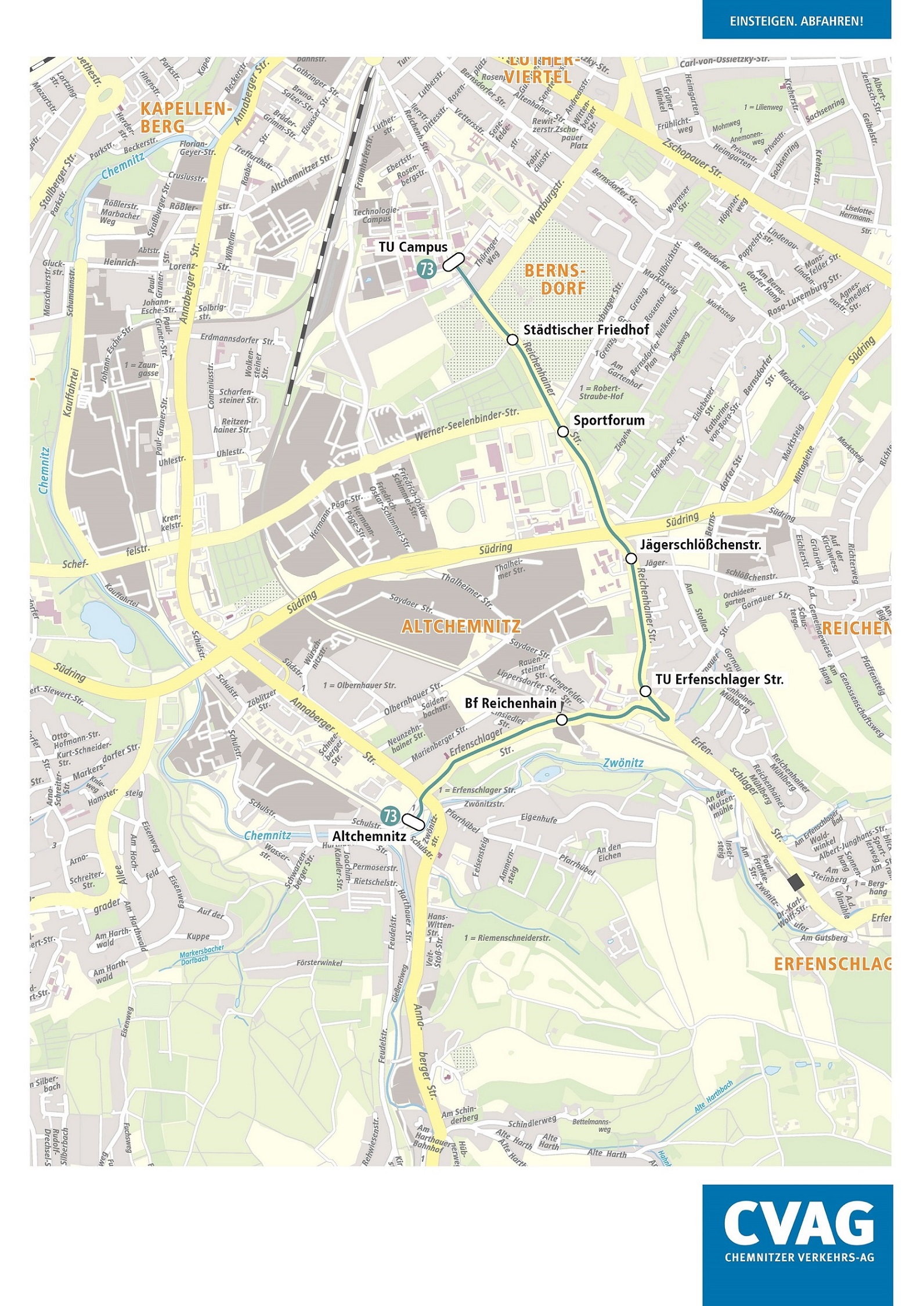
- Between the TU, Erfenschlager Str. and TU Campus stops, the frequency of the city bus route 73 will be increased to every quarter of an hour from Monday to Friday. This will improve connections to the Erfenschlag university campus as well as the sports high school and the sports grammar school to the tram line 3.
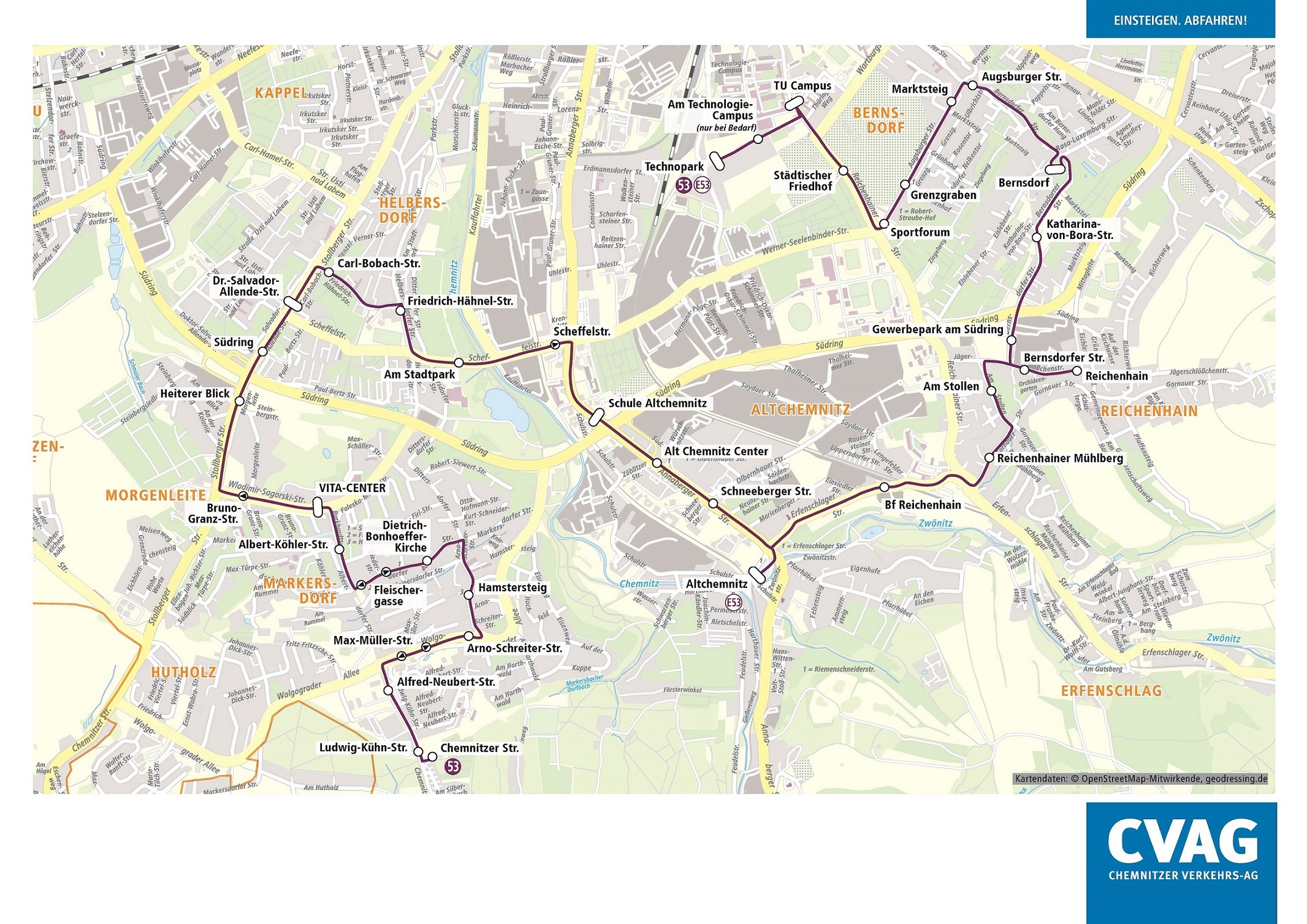
- The city bus line 53 will be routed to the Technopark terminus, but will otherwise retain its route; in the timetable position between Altchemnitz and Altchemnitz school, it will be timed more favourably as a replacement for the cancelled light rail line 6. The transfer to and from tram line 5 at the Schule Altchemnitz stop will be optimised.
- Improvements to the timetable will result in more favourable travel options for school transport, particularly on lines 63, 86 and 254.
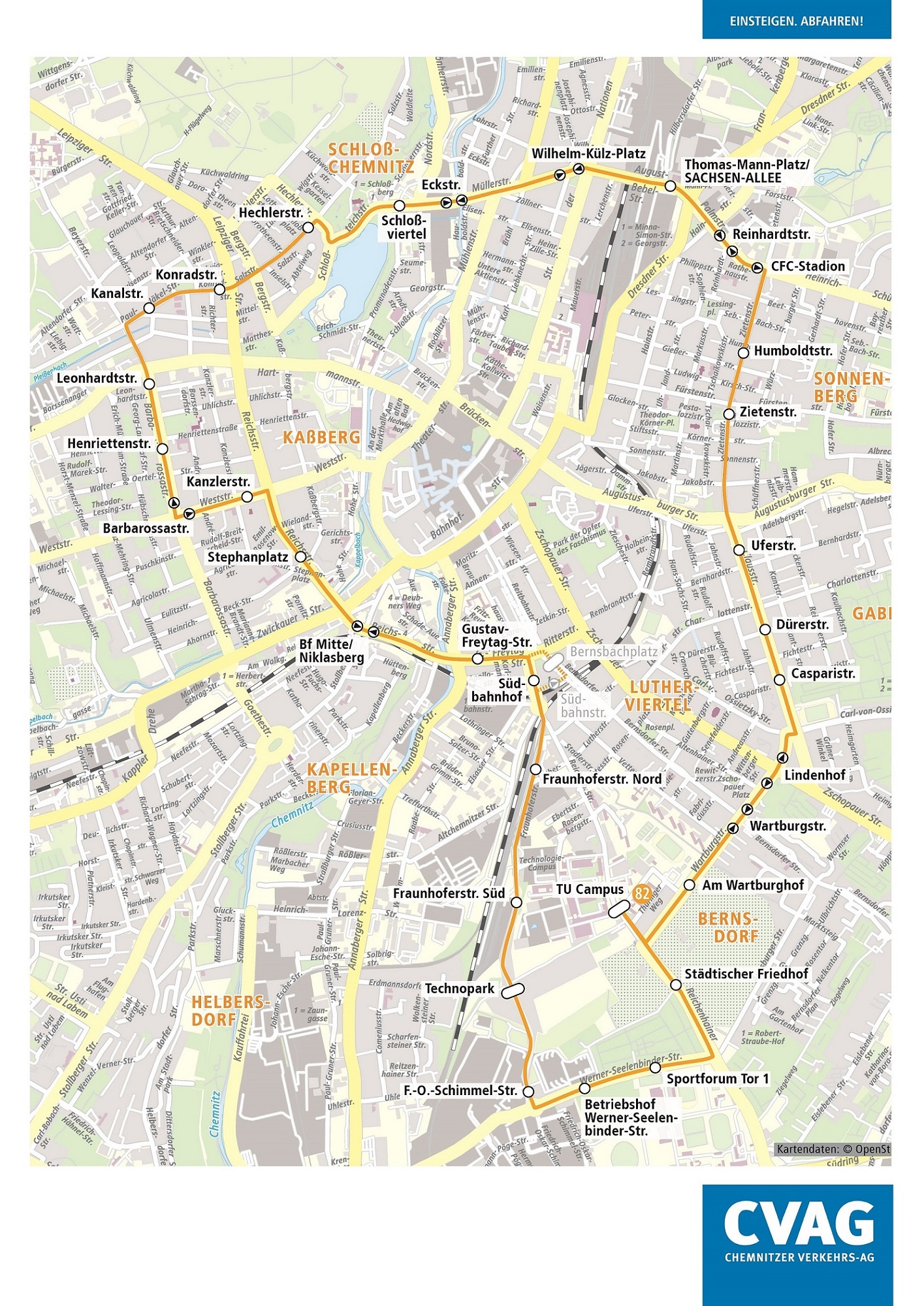
- In future, the ring bus route 82 will run continuously in both directions as a real ring bus route during rush hour. To improve the connection to the sports schools at the Sportforum, its route will be extended via Fraunhofer Str. and Werner-Seelenbinder-Str.
- With regard to the routing of route 51 via Mühlenstraße and Theaterstraße, it will be monitored until summer 2018 to see whether acceptance gradually increases as a result of the additional direct connections.
All measures are included in CVAG's current economic planning, so that no additional financial expenditure gap needs to be closed.
Background information and initial results of the network reorganisation:
Chemnitzer Verkehrs-Aktiengesellschaft (CVAG) comprehensively converted the local transport network in Chemnitz with effect from 10 December 2017. This was preceded by a multi-year evaluation of the existing network by the city of Chemnitz in close cooperation with CVAG, which - accompanied by broad public participation and discussion - resulted in the current 2017 local transport plan, which was adopted by both the Chemnitz City Council and the Central Saxony Transport Association in 2016.
The update of the local transport plan had become necessary both from an urban structural perspective and due to the comprehensive infrastructural development that had taken place in the meantime, e.g. the Chemnitz model. The 2017+ network, which went into operation on 10 December of the previous year, takes both premises into account. On the one hand, it improves the transport offer in places that were previously inadequately served, it offers completely new routes such as the ring bus line, which creates more direct connections outside the city centre, and it reduces gaps in service by extending the daytime frequency from 6 p.m. to 7 p.m. as well as making peripheral districts accessible later in the evening. The 2017+ network also takes into account the further development of the Chemnitz model, on the basis of which a new tram line on Reichenhainer Str. went into operation at the beginning of December 2017.
The last major network adjustment implemented by CVAG took place in 2008. For the changeover in December of last year, it was therefore also possible to use a wide range of statistical data such as network occupancy, boarding and alighting figures at stops, as well as simulation models of transport demand, which were not yet available when the network implemented in 2008 was planned.
The annual mileage to be provided by CVAG will increase from around 8 million timetabled kilometres to 9.3 million timetabled kilometres, which corresponds to an increase of around 15%. In the peak hour with the highest traffic volume, CVAG now has 26 light rail trains and around 90 of its own buses in operation. The fleet is supplemented by a further 35 buses from subcontractors.
In the run-up to the network changeover, CVAG was able to recruit around 40 new drivers, and a further 20 or so additional drivers have been employed by the subcontractor ETP GmbH.
The following positive examples can already be noted today:
- The extension of the daily timetable from 18:00 to 19:00 has resulted in an overall shift in the use of public transport in the evening, enabling public transport users to spend more time in the city centre and thus travel home an hour longer at an attractive 10-minute interval.
- The vehicles used on light rail line 3 are utilised to an average of 40 passengers, whereby peak loads of 120 passengers were recorded, which would have significantly exceeded the capacity of an articulated bus. Additional reinforcements, as in the operation of the old bus route 51 at peak times of lecture activity at the TU, are no longer necessary.
- The ring bus route 82 has an average capacity utilisation of 15 to 25 passengers per journey in both directions. Here, too, there are peak loads of up to 55 passengers per loop route travelled. If this trend stabilises, it can be expected that, extrapolated to a calendar year, between 500,000 and 600,000 passengers will be transported by the vehicles operating on the ring bus route, which would confirm the forecast determined by the transport model.
However, with the large number of changes, such as new timetables, different connections, new routes and altered stops, it is unavoidable that some passengers will lose the conditions they were previously accustomed to and perceived as positive. This is best illustrated by the example of the introduction of the new tram line 3. It makes neither economic nor ecological sense to run a bus alongside a new tram. As a result, more distant neighbourhoods that previously had a direct bus connection to the city, such as Reichenhain or Erfenschlag, are now only connected by changing buses. Almost everyone who did not previously have to change buses finds changing buses unpleasant, which is why it is subjectively seen as a deterioration in the transport service. However, the possible alternatives are very limited, because even if the light rail had been built on a different route, namely further along Reichenhainer Straße in the direction of Erfenschlag, this would have had advantages in the direction of the Erfenschlag university district, but most residents of Reichenhain would not have been spared having to change trains. In this respect, it is clear that in such a complex structure as a transport network of bus and rail lines, compromises must always be found with regard to possible customer wishes.