Waste collection vehicles to be fitted with fire-extinguishing systems

The Chemnitz Waste Management and Street Cleaning Service (ASR) and the Chemnitz Fire Brigade today unveiled a system they have developed themselves, which can be used to effectively extinguish vehicle fires.
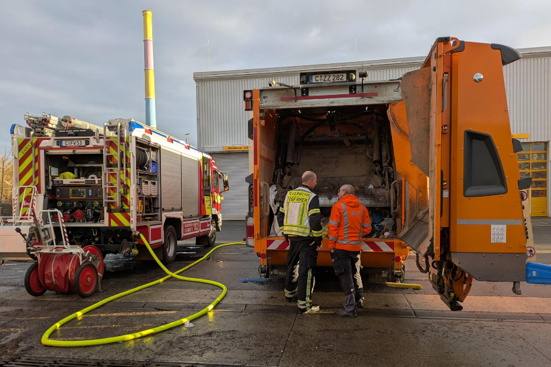
Two staff members are standing in front of a refuse collection lorry fitted with a new self-extinguishing system designed to combat vehicle fires.
The Chemnitz Waste Management and Street Cleaning Service (ASR) and the Chemnitz Fire Brigade have unveiled a system they have developed themselves, which can be used to effectively extinguish vehicle fires. Picture: Jenny Zichner
+

The statistics are clear: the number of battery fires in the waste management and recycling sector has almost tripled within five years. At the same time, around three-quarters of known causes of fire can now be attributed to lithium-ion batteries. The fleet of the City of Chemnitz’s Waste Disposal and Street Cleaning Service (ASR) is also repeatedly affected.

This is usually due to incorrectly disposed-of rechargeable and non-rechargeable batteries. As the waste is compressed under high pressure in the vehicles, in the worst-case scenario this can lead to short circuits and small explosions, and consequently to fires. The trend is on the rise, as more and more rechargeable and non-rechargeable batteries are being fitted.

In the event of a fire, ASR drivers are required to tip the load immediately to prevent costly damage to the vehicles. The burning waste is then extinguished on the open road.

However, it is not uncommon for the vehicle’s electronics to fail in the event of a fire, meaning the tipping mechanism can no longer be activated.

To address this scenario, the ASR has developed a fire-suppression system for the vehicles with technical support from the Chemnitz Fire Brigade. It enables the fire in the load to be brought under control whilst the vehicle remains closed.

Via a connection between the driver’s cab and the bodywork, water can be fed at a pressure of up to 8 bar directly to nozzles on the roof, which are positioned in front of the loading mechanism and can thus extinguish the contents effectively.

The modifications are carried out in the company’s own workshop and cost around 5,000 euros per vehicle. Ten refuse collection and bulky waste collection vehicles have been retrofitted to date. The water requirement per operation in the event of a fire is around 5 cubic metres.

For the safety of our drivers alone, it was imperative to minimise the risks posed by burning cargo. But of course, it is also a matter of keeping the follow-on costs as low as possible in the event of damage. That is why we are pleased to have found an affordable and effective solution in collaboration with the Chemnitz Fire Brigade. Nevertheless, we also hope for the support of the people of Chemnitz in ensuring that rechargeable and non-rechargeable batteries are disposed of properly. This not only prevents fires but, thanks to recycling, also secures important raw materials and conserves resources.

Marcus Kropp
Operations Manager at ASR

The increasing number of fires in the cargo compartments of refuse collection lorries is also presenting the Chemnitz Fire Brigade with new challenges. In particular, when a fire damages electronic or hydraulic components, the vehicle is often no longer able to unload its contents automatically. As a result, these fires are extremely difficult to extinguish, and the environmental impact caused by smoke, heat and contaminated fire-fighting water is very high.

To ensure rapid and effective firefighting in such cases, ASR has installed fire hoses on refuse collection vehicles and tested them in collaboration with the Chemnitz Fire Brigade. The new system is designed to enable fires in the load compartment to be tackled in a targeted and effective manner. At the same time, it is intended to help prevent major damage to the vehicles and restore their operational capability as quickly as possible.

Special thanks go to ASR and its staff for their constructive cooperation.

René Kraus
Head of the Chemnitz City Fire Service

Background

Between 2021 and 2025, a total of ten fire incidents resulting in significant property damage were recorded by the ASR; in 2026 alone, a further five incidents were added to this total. Given the high risk to drivers and the public, as well as the high follow-up costs and long delivery times for refuse collection vehicles, there was an urgent need for action and for the fire service and ASR Chemnitz to work together.