

The community is growing and celebrating
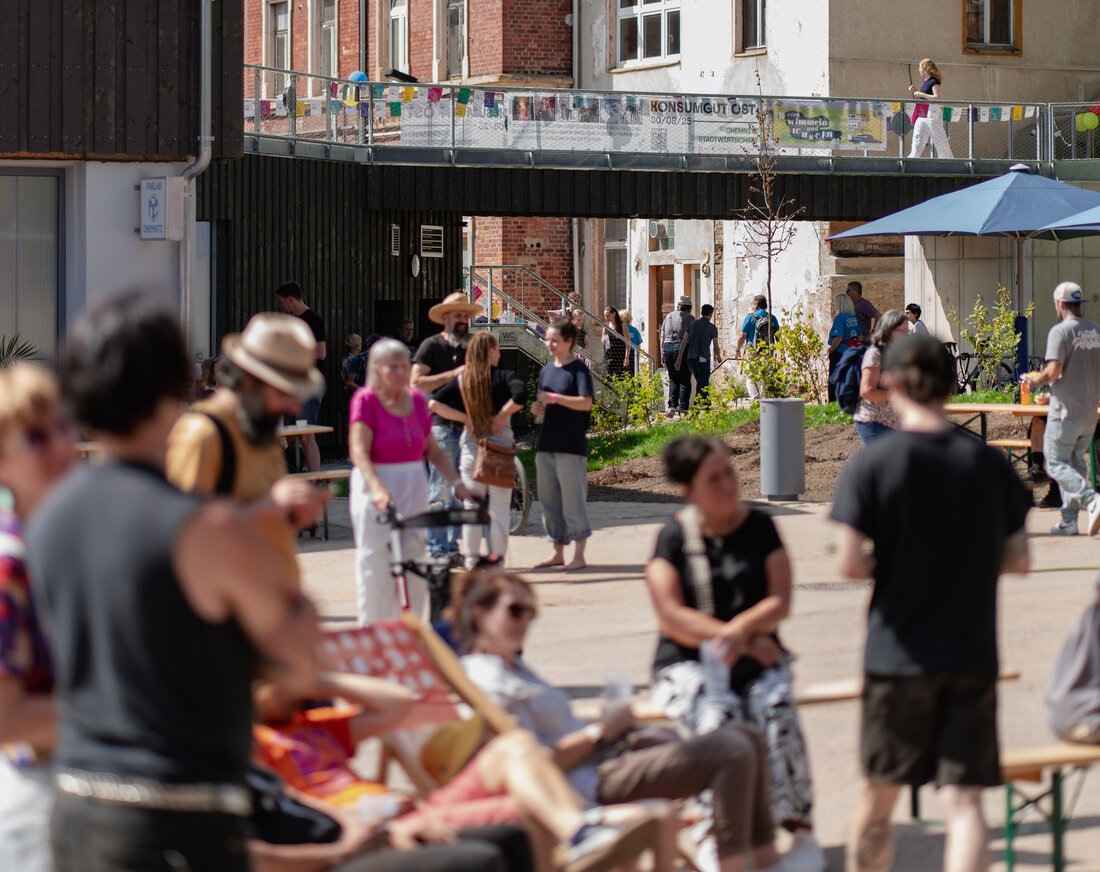


Now that construction work on the Chemnitz 2025 project site has been completed and many new tenants have moved in, the festival is even more diverse than it was at its inaugural edition last year.
The programme
Among the new players in the city’s economy are ‘CLARO!’, the coordination centre for STEM programmes in south-west Saxony; the hobby brewery ‘Braubox Chemnitz’; the chocolate manufacturer Fauch Schoki; and the Chemnitz Art Factory. They will be showcasing their work at the courtyard festival and inviting visitors to engage with them.
Numerous participants who took part last year are also offering hands-on activities. The writing and printing workshop run by ERIKA e. V. invites visitors to bring their own items of clothing and personalise them using linocut printing. At the Gründungsgarage Chemnitz, visitors can calculate their personal carbon footprint. Restorer and artist Ingo Scheller will have a wheel of fortune featuring selected vintage products. The Zeux materials initiative provides information on recycling and upcycling options and supports those interested in carrying out their own projects.
Art educator Marina Klavina invites you to the closing event of her exhibition ‘Heimat gestalten’. At the Stadtfabrikanten Chemnitz FabLab, visitors can take part in various hands-on workshops and exchange experiences with makers. The Museum of Natural History is also taking part in the courtyard festival with a fossil workshop.
The programme is complemented by a variety of musical and cultural performances on stage. Among other things, there will be an auction at which selected artefacts from the archives of the city’s economy and its key figures will be put up for sale. Musical entertainment will be provided by, amongst others, the rapper Big Buddha and the EDM project Freuth.
Those interested can explore the Stadtwirtschaft site on two guided tours at 3 pm and 4 pm. Each tour lasts around 45 minutes and offers insights into the site’s development, with a particular focus on the measures implemented as part of the ‘National Urban Development Projects’ funding programme.
Support & Personalisation

With support from the federal programme, numerous projects have been carried out in recent years to personalise the Kreativhof and strengthen the sense of community on the site. These involved stakeholders from the city’s business sector, from Chemnitz and beyond. Among the projects that have emerged are the so-called ‘Fleximöbel’ – versatile outdoor furniture for events. The prototype and a small production run were designed by Leopold Rubahn, a graduate of the Faculty of Applied Arts in Schneeberg at the West Saxon University of Applied Sciences in Zwickau, and produced in collaboration with Holzkombinat Chemnitz and Stadtfabrikanten Chemnitz. In addition, several façades of the Stadtwirtschaft were designed by established street artists and emerging artists. The Zeux materials initiative, FabLab Chemnitz and the artists Ingo Scheller and Marina Klavina jointly developed a large book-swap cabinet, the Stadtwirtschaft’s ‘Bücherpforte’ (Book Gate).
In collaboration between the Stadtwirtschaft team and the agency Haus E, a new wayfinding system was also created. Four 2.70-metre-high Stadtwirtschaft sculptures now indicate the various areas and points of contact within the site.
Numerous ideas from the community workshops held previously were also incorporated into the site’s further development. These include covered outdoor workspaces, rainwater collection points and an urban gardening area. The site has been enhanced with facilities for sporting activities, including a mini bouldering wall, a basketball hoop and calisthenics equipment, as well as additional seating and relaxation areas.
Since this summer, four goblins have also been part of the urban landscape. The figures draw on the history and development of the site and provide information about the location. Their creation was made possible by a 10,000-euro ‘Euja!’ grant from the City of Chemnitz, as well as further funding from the City of Chemnitz and the federal programme ‘National Urban Development Projects’.