

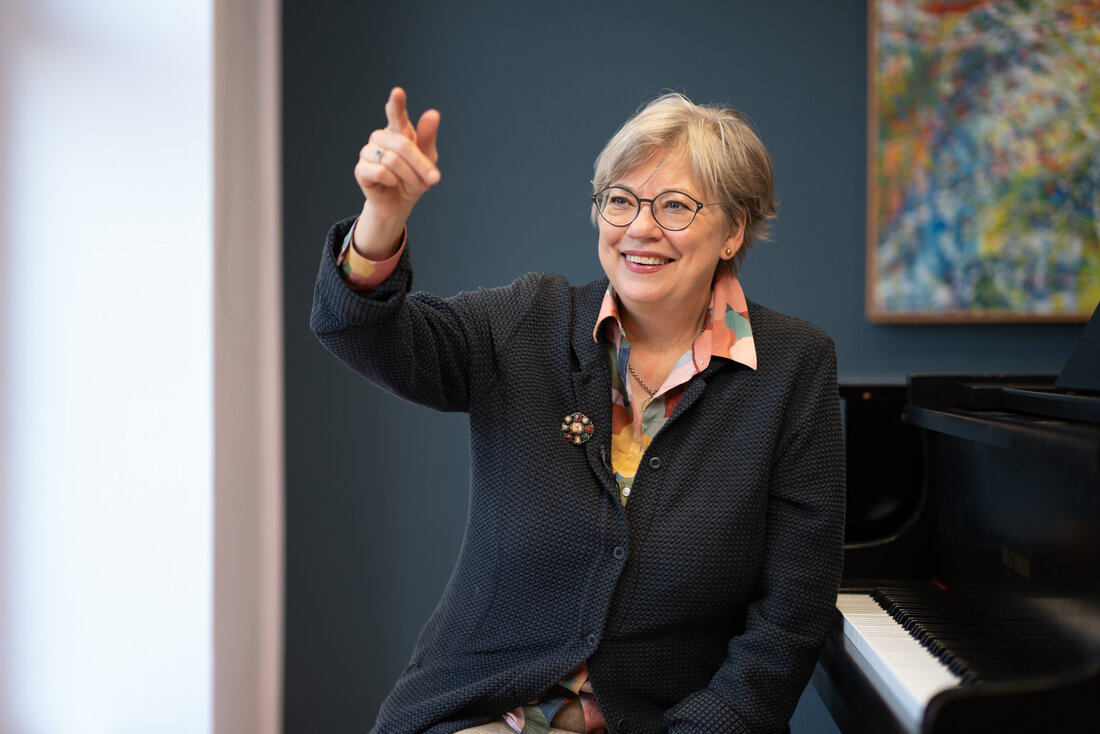
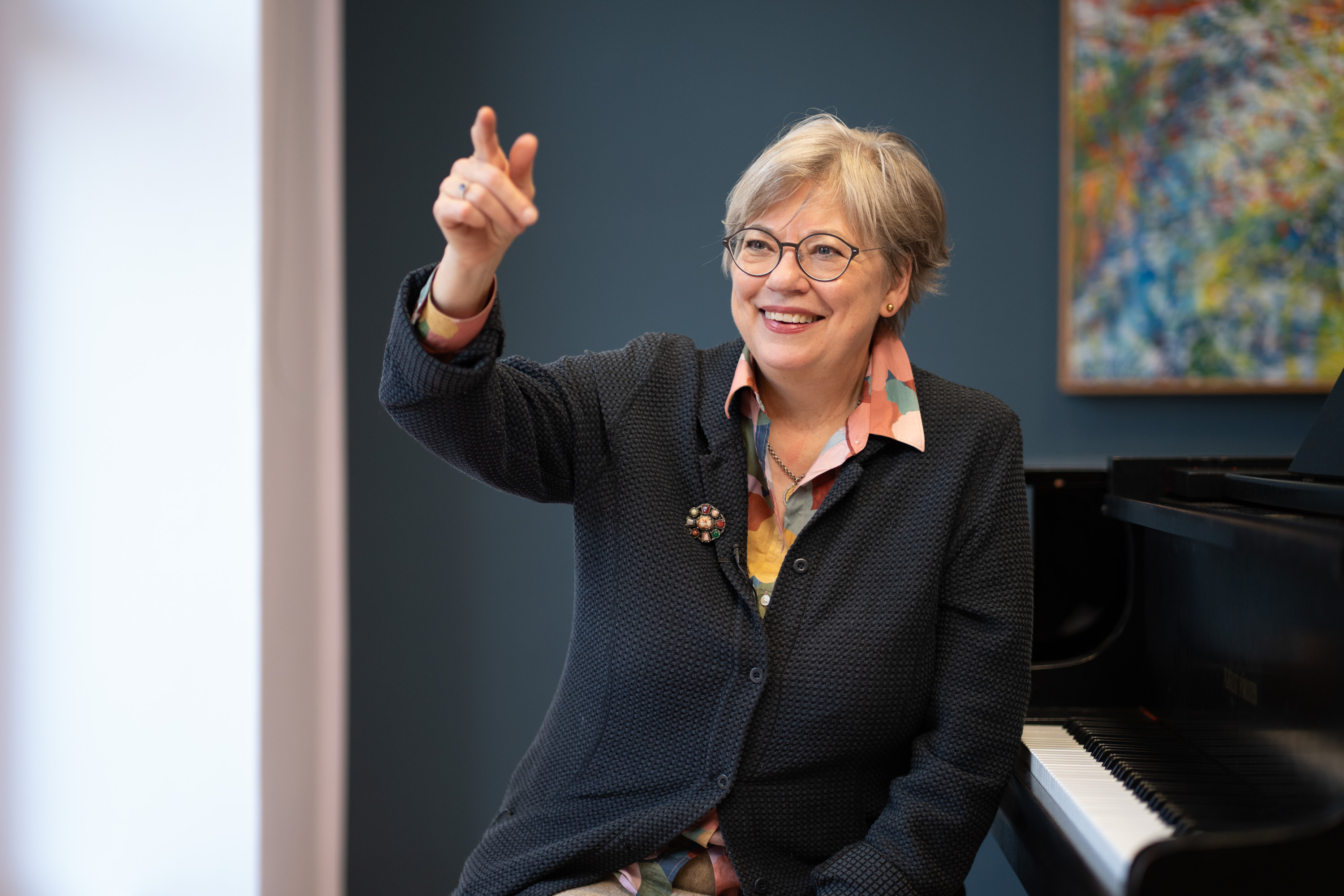
The interview took place during her final week at work. With her office already half-cleared out, the chamber music hall was chosen as the venue for the conversation. It had been decked out in new colours a few days earlier, designed by Frank Maibier. The conversation began with a round of quick-fire questions.
Music school in a word: enthusiasm

Which is harder? Starting or stopping?
Nancy Gibson: Stopping . Or rather, bringing it to a close.
Which is more important, rehearsals or the concert?
The concert.
Music school in three words.
Joy. Concentration. Beauty.
What sound epitomises music school?
The sounds you hear on a Thursday afternoon when you’re standing outside the music school.
Stage fright – friend or foe?
Both.
Which musical instrument would you still like to have learnt?
The clarinet. Or the bagpipes. Both.
Which is harder? Finding the right note or holding it?
Holding it.
What remains once the last note has faded away?
Satisfaction.
Your favourite moment at music school in one word.
Phew, that’s a tough one… But: enthusiasm!

Let’s go into more detail. What’s behind this enthusiasm?
I’m simply thrilled by the music school. It’s hard work, mind you, and not always easy, because there’s such a wide range of voices and so many different opinions. But it’s just incredible to see a nine- or eleven-year-old standing on stage, completely focused. This hands-on effort by young people to learn to work in such a complex way, to do so many different things at once. Listening, understanding the music, motor skills, working together with the teacher and also amongst the pupils themselves. All these facets are interwoven. It’s a fascinating process to observe. And then music emerges, art emerges. I’ll remember that until the day I die.
Which encounter from the past 17 years at the music school will stay with you forever?
Apart from the ones I’ve just described, I particularly remember an encounter in 2018. We had an ensemble from Leeds visiting us and were due to perform at the town festival. Then the riots broke out and everything was cancelled. And our partners from Leeds – those wonderful people – understood the situation. They said straight away that it could just as easily have happened to us. They were supportive and cooperative. That’s the sort of thing you see amongst ensemble leaders who work with young people. That flexibility and good-naturedness – I’ll never forget it.
How has the music school changed since 2009?
Physically, of course, we have a new concert hall and new rooms. The whole building has been renovated from top to bottom, even though there’s still potential in the cellar and the loft. But the most important thing is that, since 2025, we’ve taken on many teachers on permanent contracts – 63, to be precise. Not all of them are full-time, of course, but that makes an enormous difference to the way the music school operates.
What was it like working with the teaching staff?
Without the teachers and the administrative staff, I wouldn’t have been able to do anything; none of these changes would have been possible. Teaching is always evolving. But we’re a team, we’re all in the same boat and everyone’s pulling their weight. I’m very grateful for that.
What are you looking forward to in retirement?
Monday mornings, when I don’t have to get up.
Will you be staying in Chemnitz?
Yes, and I’ve got plenty planned. I’ve already agreed to sit on various committees. My priorities are promoting reading and democracy. And I’d like to do more sport. I know, everyone says that (laughs). I’m still involved with the Chemnitz Music Society and I’m looking forward to finding more time for theatre, opera and ballet. I’ll be sorting out a senior citizen’s season ticket.
Will you still be involved with the music school?
Well, I won’t be walking round here just to see how they’re doing things now. Of course I’ll come to concerts, but as a private individual. It’ll feel a bit strange at first. I’ll be going to the music school and I won’t be able to just pop into my office or see my colleagues. I’ll have to stick to the office hours.
Do you have a message for your successor?
I won’t be offering any clever advice. I hope that they’ll manage just fine. Working at a music school is a rollercoaster ride, and the early days are always tough. My wish for them is that they can put their plan into action and that it will be a good one. I’m really incredibly curious. It’s the right time for a change of direction. We need a new generation that understands the path to the future. I can’t really picture that anymore. I’m too old. But a young person who is 20 or 30 years younger than me sees the future completely differently and knows which direction we need to take. I hope my successor will be successful in this.
About the person

Nancy Gibson was born in Toronto, Canada, in 1961 and received her early musical training on the piano and violin. She studied singing in her home country and later in London and at the Glasgow Opera School. She has called Chemnitz home since 1992 – with her husband, a German cellist. Nancy Gibson was a member of the Chemnitz Opera ensemble for 16 years before moving to the Municipal Music School as its director in 2009. She is now retiring.