

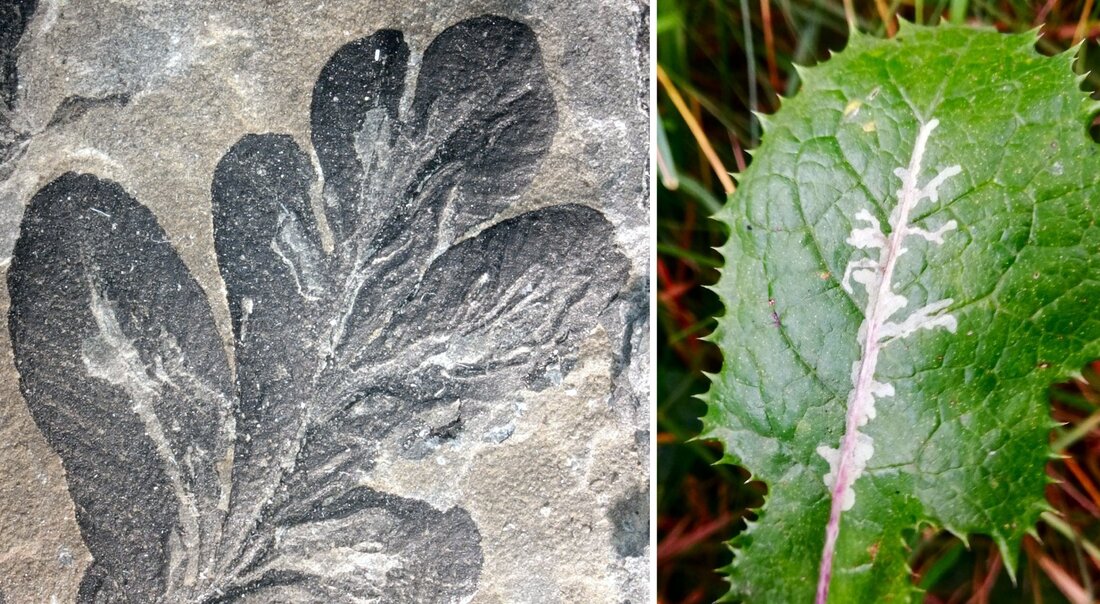
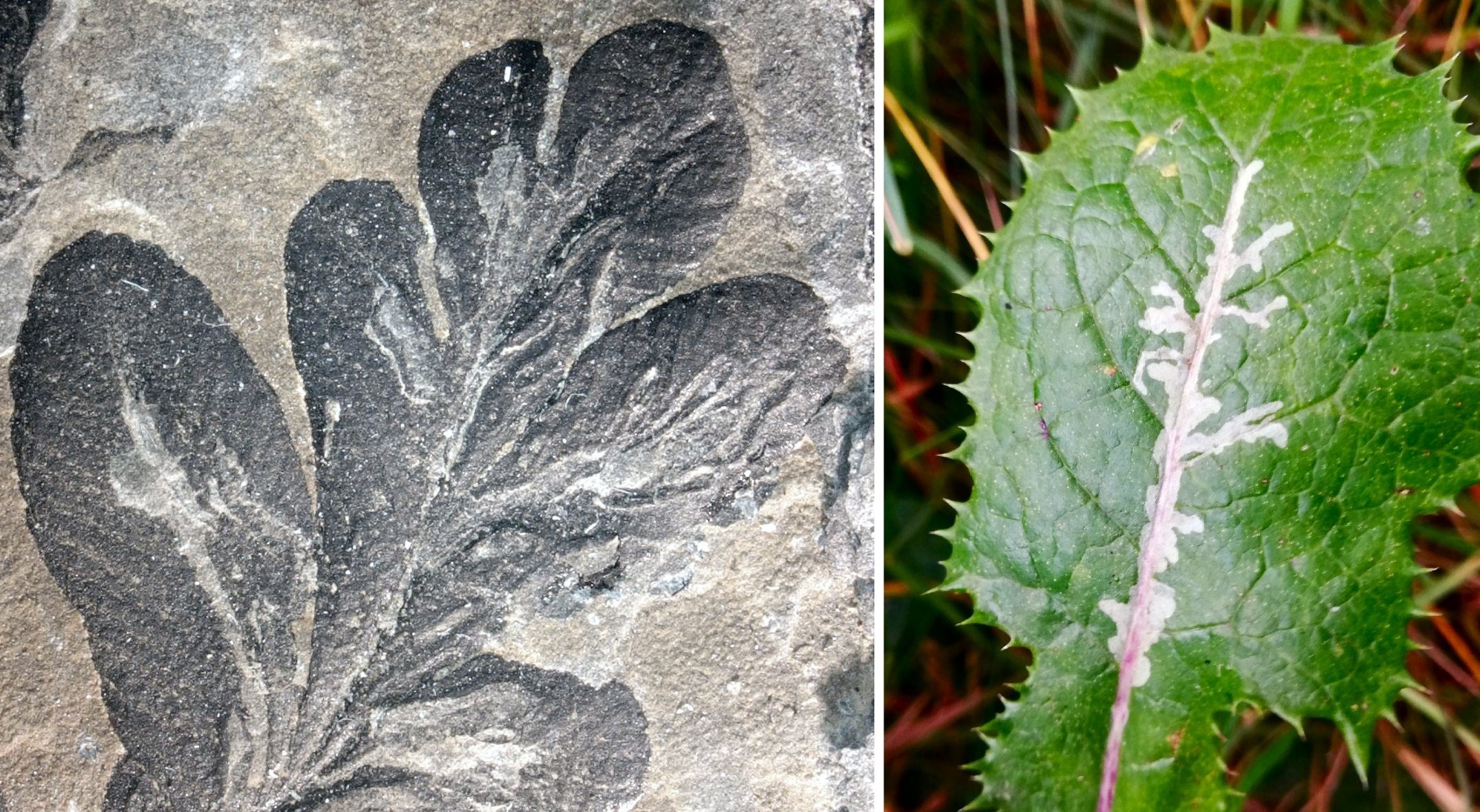
A team of scientists from the natural history museums in Chemnitz, Berlin, Münster and Osnabrück, the TU Bergakademie Freiberg and the Martin Luther University Halle-Wittenberg have used state-of-the-art research methods to prove that leaf mines existed more than 40 million years earlier than previously assumed.
The first author of this publication is Michael Laaß, a scientific trainee at the Museum für Naturkunde Chemnitz. The publication is part of his doctoral thesis, which he recently submitted to the TU Bergakademie Freiberg.
The researchers had access to the rich palaeobotanical collections of the natural history museums in Berlin, Schleusingen and the Freiberg Mining Academy, which proved to be real treasure troves for science: These contained numerous exceptionally well-preserved specimens of the feeding traces in question, Asteronomus maeandriformis, on leaflets of the fern seed Autunia conferta, which originate from approximately 295 million-year-old deposits from the Permian geological age of the small former coalfield in Crock in Thuringia.
The perfectly preserved plant fossils allowed the unambiguous conclusion that insect larvae produced the feeding tunnels protected inside the leaves. In addition, it was possible to identify the egg deposits belonging to the feeding galleries, which in some cases even still contained the remains of insect eggs. The frequency of these fossils is also spectacular: in total, more than 80 per cent of all Autunia plants from Crock were exposed to an infestation of leaf mines, which can rightly be described as the oldest insect infestation in the history of the earth. Exactly why the Autunia plants from the Crock locality were infested en masse remains a mystery. However, the phenomenon occurred at a time of global change, during which tropical land ecosystems gradually became drier.
Whether you are a farmer, gardener or walker, you have probably noticed the intricate feeding tunnels of insect larvae inside leaves, also known as leaf mines. Living among plant tissue has many advantages: Well protected from enemies, dehydration and disruptive environmental influences, the larvae have an almost inexhaustible supply of food at their disposal, like a "maggot in bacon". Nowadays, leaf mines are produced exclusively by insects such as beetles, dipterans, wasps and butterflies, which undergo a complete metamorphosis and are therefore known as holometabolous insects. They are highly adaptable and in the course of evolution have developed slender, maggot-like larvae without body appendages that are optimally adapted to life inside plant tissue.
Until now, it was unclear when this successful strategy evolved in insects. The oldest reliable evidence of leaf mines to date comes from the Triassic, the early Mesozoic.
Original publication:
Laaß, M., Luthardt, L., Trümper, S., Leipner, A., Hauschke, N. & Rößler, R. 2025: Host-specific leaf-mining behaviour of holometabolous insect larvae in the early Permian. scientific reports 15: 31241.
https://doi.org/10.1038/s41598-025-15413-x