

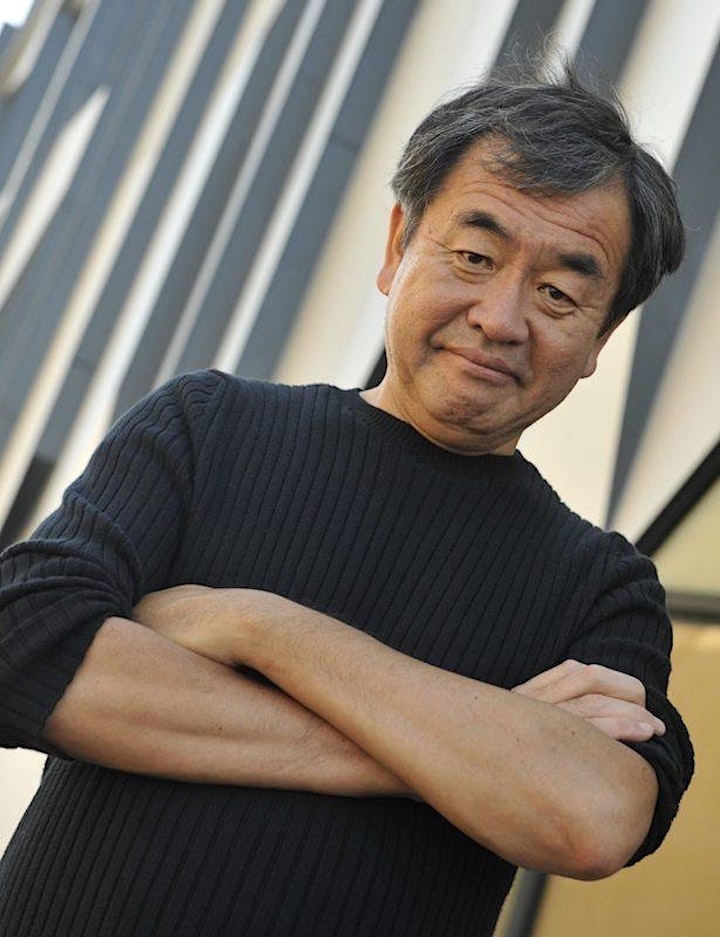
On Whit Sunday, 8 June at 6 pm, the internationally renowned Japanese architect Kengo Kuma will once again be in Chemnitz. At the Kunstsammlungen am Theaterplatz, he will be talking to Frei Otto's daughter and long-time collaborator Christine Kanstinger and other guests about the life and work of the famous architect, scientist and inventor, who was born in Siegmar 100 years ago.
Registration for the event is required via the City of Chemnitz's participation portal at https://buergerbeteiligung.sachsen.de/portal/chemnitz/beteiligung/themen/1053447.
The talk is part of the current exhibition "Beyond geometry. Frei Otto x Kengo Kuma", which can be seen at the Kunstsammlungen Chemnitz until 29 June 2025.
To accompany the exhibition, on Saturday 31 May at 1 p.m. in the University Library of Chemnitz University of Technology, Straße der Nationen 33, the editors, some of the authors and experts will present the volume "Frei Otto. Building with Nature". This is being published to mark the 100th anniversary of Frei Otto's birth. Registration is required for the event at https://buergerbeteiligung.sachsen.de/portal/chemnitz/beteiligung/themen/1052701.
Frei Otto's internationally acclaimed work appears more topical than ever, which is due to the current relevance of the issues he addressed. It is above all the ecological hardships of the present day and the new demands on contemporary architecture derived from them that make Otto's long-standing search for a desirable relationship between nature, technology and society a hot topic once again.
The book, which has been published by saai - Archive for Architecture and Civil Engineering at the Karlsruhe Institute of Technology, is intended to take account of the pluralism of Frei Otto's concepts and images of nature, which is reflected in the heterogeneity of the assembled contributions by international authors. On the occasion of the presentation of the volume, this circle will be further expanded in Chemnitz by inviting young architecture firms and prominent critics to discuss current issues in Otto's work.
The book launch will be moderated by the publicist and author Sandra Hofmeister and the architectural theorist and Vice President of the Berlin Academy of Arts, Berlin, Anh-Linh Ngo. Among the authors present will be Dr Walter Scheiffele (design theorist and former visiting professor at the Weißensee School of Art) and Prof Jos Tomlow (former professor for the fundamentals of design and monument preservation at the Zittau University of Applied Sciences).
Background
Both events are taking place as part of "100 Years of Frei Otto" - the series of events organised by the Garage Campus and the City of Chemnitz on building culture for the European Capital of Culture Chemnitz 2025.
The German architect Frei Otto is one of those personalities who are generally associated less with his birthplace of Chemnitz Siegmar and Saxony. The city of Chemnitz and the Garage Campus, the intervention area of the European Capital of Culture, are taking his 100th birthday on 31 May in Chemnitz's title year as European Capital of Culture as an opportunity to make this connection more visible - true to the Chemnitz Capital of Culture motto "C the unseen".
Frei Otto is one of the world's most renowned architects of the 20th century. He is famous for his tent-like, filigree roof constructions, which were created using lightweight construction methods. Perhaps the most famous of these is the roof of the Munich Olympic Stadium. He was inspired by nature and is one of the most important representatives of organic architecture. His aim was to build light and flexible structures using as little material and energy as possible. For his roofs, which often seem to float above the buildings, he used steel cables, nets, arches or umbrellas.
The Kunstsammlungen Chemnitz, the City of Chemnitz and the Garage Campus have put together a multi-part programme with numerous partners and supporters, consisting of events, an international summer summit and the exhibition.
Kengo Kuma
With his buildings, the Japanese star architect Kengo Kuma is committed to the nature and tradition of Asia: "The essence of my work is the use of natural materials to create airy, open spaces filled with sunlight," says Kengo Kuma, describing his aim. In his architecture, Kengo Kuma succeeds in effectively combining archaic materials, traditional Japanese architecture and innovative technologies.
In addition to sustainable design and progressive thinking, Kengo Kuma and Frei Otto share the same task at different times: The planning of an Olympic stadium. Together with Günther Benesch, who grew up in Chemnitz, Frei Otto planned the stadium for the 1972 Olympic Games in Munich. Kengo Kuma, on the other hand, was allowed to design the Tokyo 2020 Olympic stadium in the spirit of "humanity, nature and intimacy", according to his own statement.
In January 2024, Kengo Kuma had already given a lecture entitled "Go back to nature " in the central lecture theatre at Chemnitz University of Technology in front of an audience of around 500 as part of the "100 years of Frei Otto" series.