

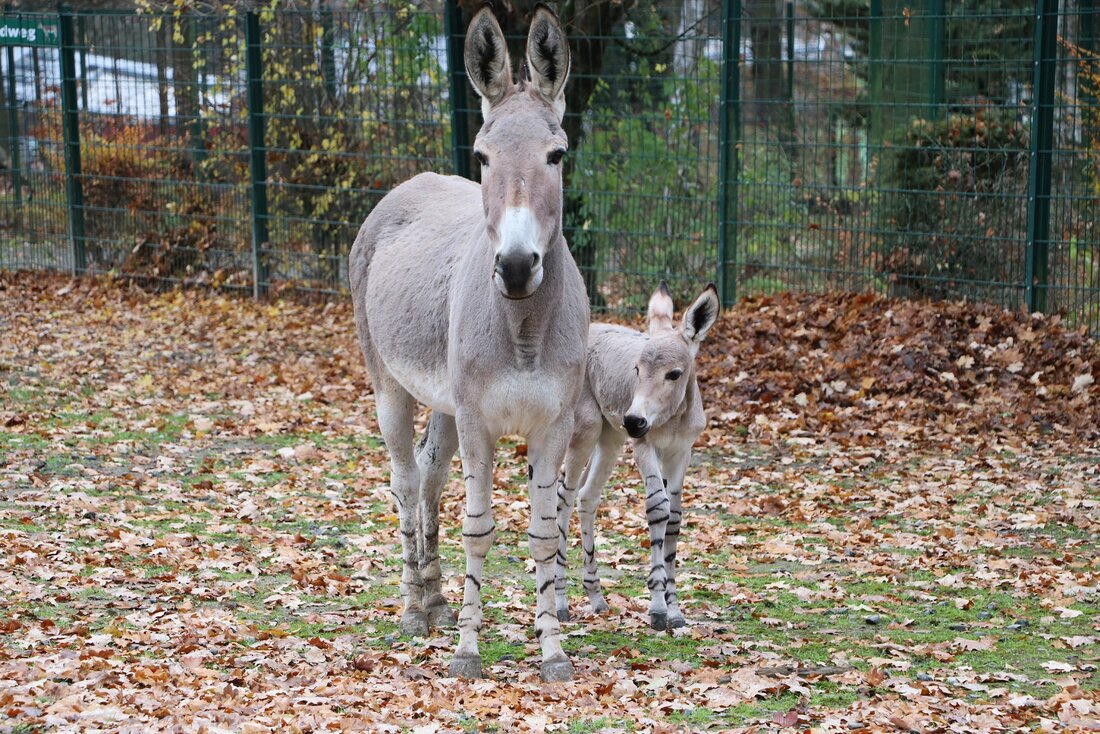

In mid-November, there was a rare birth at Chemnitz Zoo. In the early hours of 14 November, a female Somali wild ass foal was born. The foal has been named Medea. The birth is a success for species conservation.
The mother mare, Hera, and her foal can already be seen in the outdoor enclosure. The stallion is currently still being kept separately. Among Somali wild asses (Equus africanus somaliensis), mothers and their young form the only stable social units. Adult stallions, by contrast, often live as solitary animals.
The species is a subspecies of the African wild ass, the wild ancestor of today’s domestic donkeys, and is classified as critically endangered. Only a few wild animals remain in Ethiopia and Eritrea. They have already disappeared from the rest of their original range. The greatest threats include hunting, limited access to water and food, and interbreeding with domestic donkeys.
Chemnitz Zoo has been keeping Somali wild asses since 1997 and is thus actively involved in the international conservation breeding programme.
Medea is one of only 14 foals born in European zoos in 2026. Medea’s birth is therefore far more than just a welcome breeding success: it is an important contribution to the conservation of this critically endangered species and a further step towards ensuring its long-term survival.
In 2015, it was estimated that there were only between 23 and 200 adult African wild asses – a group to which the Somali wild ass belongs – remaining in Ethiopia and Eritrea, with numbers on a downward trend (IUCN Red List 2015). By contrast, 225 animals were held in zoos worldwide, 150 of them in Europe (Species360 ZIMS).